
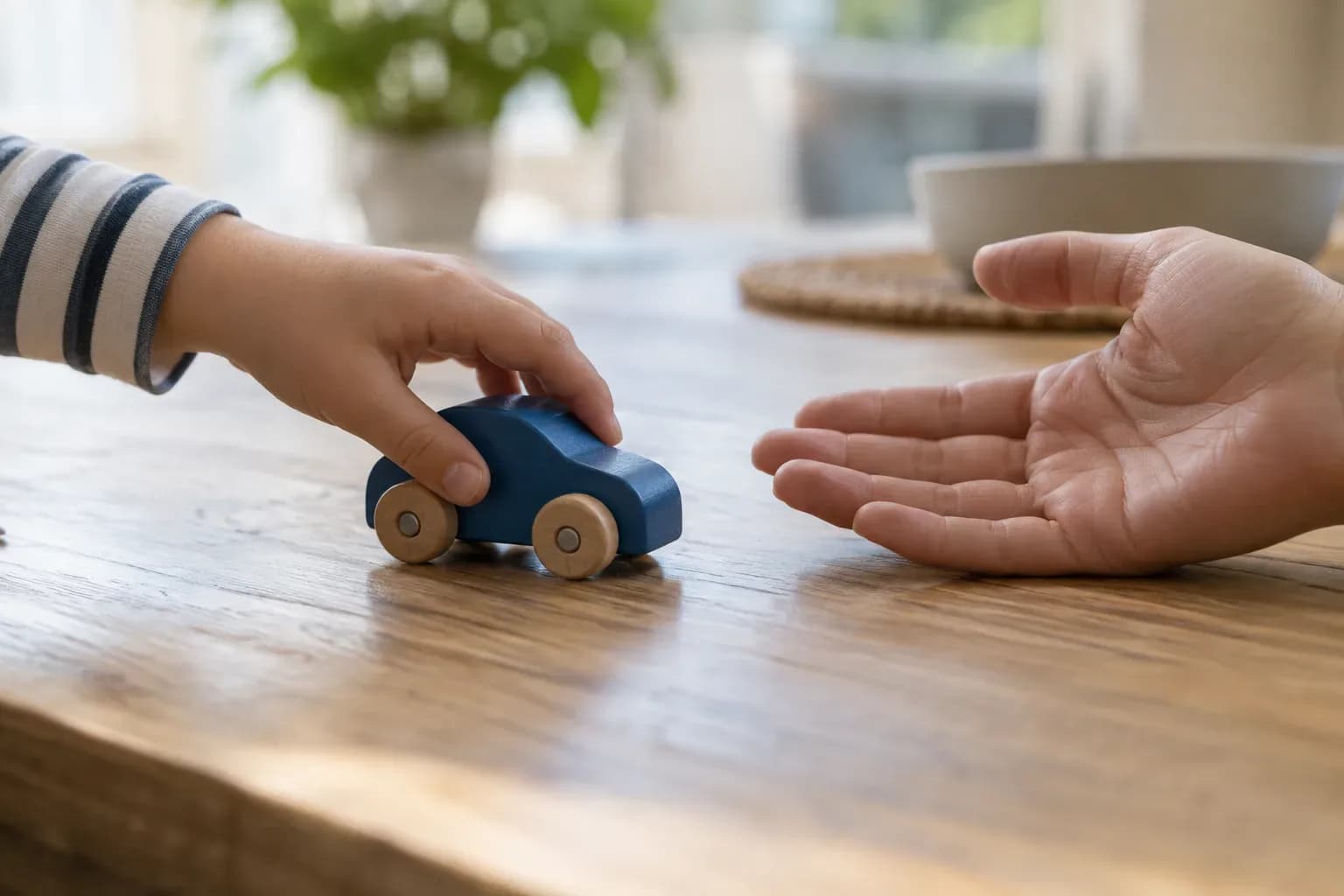
A shared action and shared attention. An AI-generated illustrative scene, not a demonstration of a specific protocol.
An autism support programme starts with the child's needs: communicating a wish, understanding what comes next, joining in play and managing everyday activities. ABA, TEACCH, PECS and Floortime refer to different approaches and tools. A list containing all four names does not yet explain what the child will do or how the team will assess changes.
Hansi's programme materials describe assessment, individual goals, observation and review. The definitions below explain the terms, followed by the centre's documented structure. The four approaches are not a prescription for every child.
Start with the child's goal
“Developing communication” is a broad goal. A more specific discussion might concern a way for a child to request a toy they want. Another might focus on understanding a sequence of activities or taking part in shared play. These are examples of possible goals, not accounts of children's results at Hansi.
The centre's ABA materials include individual goals and data recording. This connects each session with what the team will observe. The question is both which session appears in the plan and which need it addresses.
For example, making a request and answering a question should not be merged into a vague statement that a child “communicates better”. They are different actions. Being near an adult who is playing and participating in a back-and-forth exchange are different observations too. A clearly described goal makes discussion of the programme easier for the family to follow.
What the four names mean
| Approach | Meaning | What it helps explain |
|---|---|---|
| ABA | Applied behaviour analysis: a field from which different teaching approaches have developed | How a skill is defined and learning is analysed |
| TEACCH | Structured teaching using organisation of the environment and visual supports | How the sequence of an activity can be made more understandable |
| PECS | An augmentative and alternative communication system using picture exchange, with a defined protocol | How a person can communicate messages through pictures |
| Floortime | Practical application of the DIR model through interaction with the child | How interaction takes account of development and individual differences |
ABA. The term covers several teaching approaches, rather than one fixed set of exercises. This follows the description provided by the BACB. The word ABA on a timetable therefore does not specify the individual goal or the content of a session.
TEACCH. The University of North Carolina TEACCH Autism Program describes structured teaching through physical organisation, individual schedules, activity systems and visual supports. It concerns how the environment and materials are organised, rather than simply whether there are cards on a wall.
PECS. Pyramid Educational Consultants defines PECS as a communication system with a six-phase protocol. Its primary goal is functional communication: conveying a message to another person. Not all picture cards constitute PECS, and using the system does not promise spoken language. This is a definition of the system as a whole.
Floortime. ICDL distinguishes the DIR model from its practical application, Floortime. The model considers development, individual differences and relationships. It helps explain why shared play can have a particular purpose, but does not make every play activity Floortime.
These definitions are not a ranking and do not establish equal evidence for all four approaches. The choice of a component and its role in a programme need individual discussion.
Communication, sequences and shared play
Three educational examples help illustrate the difference between goals.
Making a request. The focus is a way for the child to communicate what they want. The discussion concerns communication, rather than a number of words they must say by a deadline. The specific means of communication is selected individually.
Understanding what comes next. This goal concerns the organisation of an activity. A visual sequence may form part of that work. A picture showing the next step is different from a picture the child uses to communicate a message to someone else.
Sustaining an exchange during play. Here the focus is reciprocal interaction. Hansi's Floortime materials describe the child's interests as a guide for the work. A goal can concern joining an exchange of actions, rather than requiring a particular facial expression or mandatory eye contact.
These examples are not instructions for delivering therapy at home. They explain why different components may matter to a family, and why a method's name does not replace a clear goal.
Hansi's documented weekly structure
The centre's methodological document describes a four-week structure. The table below summarises its educational component: the sequence of work, not an actual child's case or a promise of results within four weeks.
| Stage | Main emphasis in the centre's document |
|---|---|
| Week one | Adjustment, initial assessment and starting activities |
| Week two | Work on individual goals |
| Week three | Independence alongside parent training |
| Week four | Clarifying next priorities, final assessment and preparing the home plan |
The document includes daily observation and a weekly discussion to review the plan. The weeks organise the work; they do not mean that any particular skill must emerge by a set stage.
The combination of sessions is selected for the child. Hansi's materials describe ABA, TEACCH and Floortime, but the course structure does not make all four approaches in this article's title compulsory.
What practitioners assess
Hansi's developmental assessment form covers eight areas:
- perception;
- gross motor skills;
- fine motor skills;
- speech and communication;
- cognitive development;
- social interaction;
- self-care;
- emotions and behaviour.
A clinic practitioner completes the form. It is not a self-test for parents or a way to diagnose a child through an article. The areas show that discussion of a programme covers different aspects of development, rather than speech alone.
The practitioner connects observations with the next goals. This helps the family understand the purpose of the work and why the plan is reviewed.
Parents, feedback and changes to the workload
Hansi's documents provide for feedback to families after a session. Daily parent training is included from week three, followed by practising home activities under a practitioner's guidance. Family participation concerns learning specific activities; it does not make parents responsible for delivering a promised outcome.
The treating doctor can reduce the number of daily sessions at a parent's request. A change to the plan is different from cancelling an already scheduled session. Under Hansi's rules, cancellation less than six hours before a session incurs the full fee, apart from specified exceptions for acute illness; tiredness alone does not waive the fee. This is a payment rule, not advice to continue a session when a child is unwell.
Difficulties and how the child tolerates sessions are discussed with the team when the plan is reviewed. Regular review does not itself guarantee a particular pace of change.
The home plan and contact after the stay
At the end of the course, the rehabilitation report and home activity plan are provided in Chinese with a Russian translation. Under the centre's rules, documents are issued after full payment. The home plan relates to the individual child's work; a general explanation of four approaches does not replace it.
Before and after the stay, contact is available through a messaging service via the interpreter-coordinator and by email. The coordinator can arrange the transfer of existing medical reports and discussion of further questions.
Discuss programme goals with Hansi
If you are considering Hansi, contact the coordinator through the website's contact page. You can discuss goals for your child's support and agree how to share medical reports. Send documents through an agreed channel with the consent of the child's legal representative.