
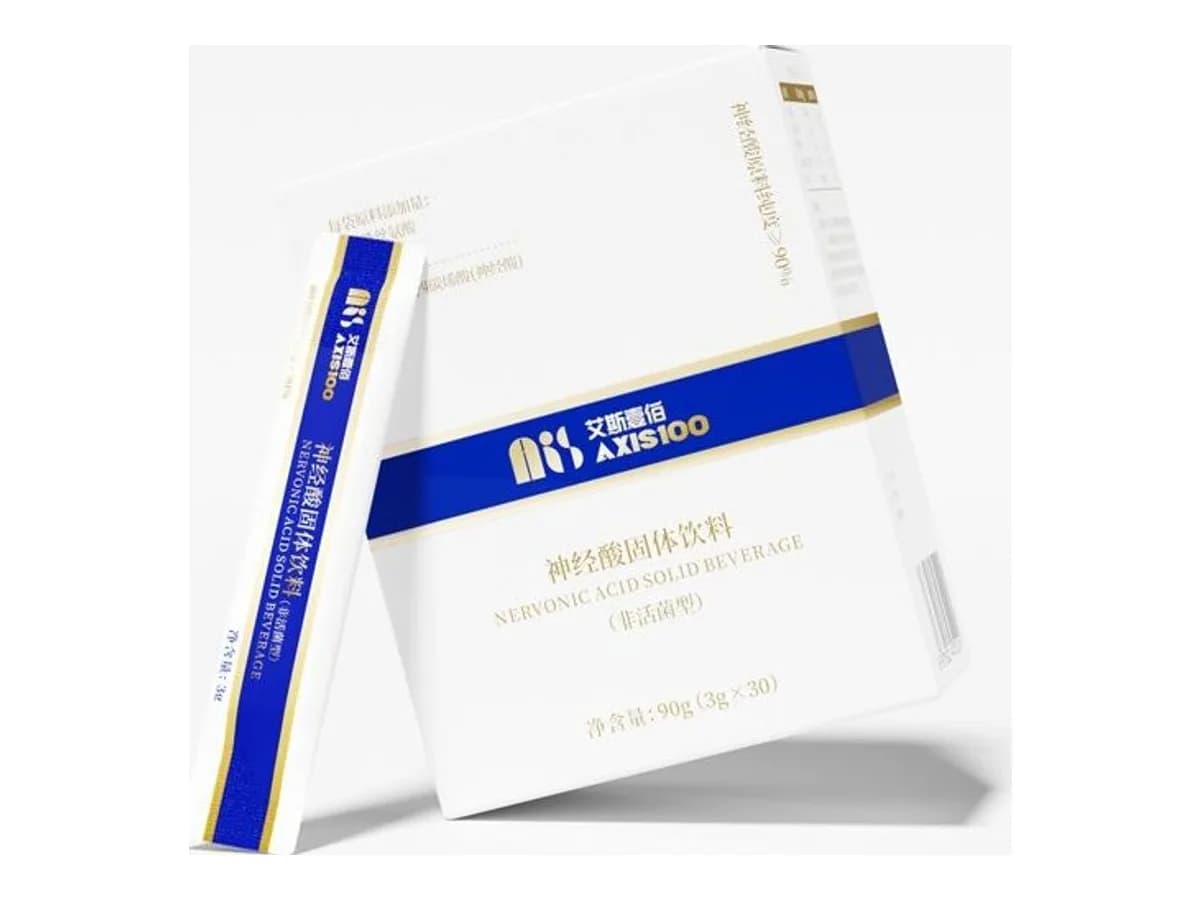
AXIS100 — Nervonic Acid Solid Drink / 艾斯壹佰 神经酸固体饮料
A Chinese functional-food product: a nervonic acid solid drink intended as nutritional support for the brain and the nervous system. Not a medicine.
Download PDF: composition breakdown (RU)Product description
AXIS100 (艾斯壹佰) is a Chinese functional-food product: a solid drink (固体饮料) built around nervonic acid. It is intended as nutritional support for the brain and the nervous system, not as a treatment for disease. The manufacturer's idea is not a single active substance but a coordinated set of ingredients working in four directions at once: restoring the structure of nerve fibres, strengthening signal transmission, improving the gut environment and protecting neurons from age-related wear. The manufacturer calls this a four-level matrix and describes it as all-round support along the gut–eye–brain axis.
Composition: the four-level matrix
The figures below are per one 3 g sachet. Statements about what each ingredient does follow the manufacturer's own materials and the publications it cites; they are not a promise of any result.
Level 1. Restoring nerve structure
A nerve fibre is wrapped in a myelin sheath, which is easiest to picture as the insulation on an electrical wire: damaged insulation makes the signal slower, noisier, or lets it disappear altogether. The first level targets that insulation and the nerve cells themselves.
- Cis-15-tetracosenoic (nervonic) acid — 45 mg. A fatty acid and one of the building materials of the myelin sheath; it can cross the blood–brain barrier, the natural filter between blood and brain. According to the manufacturer it helps repair damaged nerve pathways and improve signalling between brain cells. The pack declares a raw-material purity of ≥ 90%.
- N-acetylneuraminic (sialic) acid — 10 mg. Takes part in how nerve cells communicate with each other, supports brain development and immunity. Research on this ingredient has been carried out by FrieslandCampina among others.
Level 2. Strengthening signal and memory
Where the first level deals with the wiring, the second deals with the quality of the signal itself: how fast the brain processes information and how long it holds on to it.
- Phosphatidylserine (PS) — 260 mg. A phospholipid found in the membranes of nerve cells. It improves memory and cognitive function, takes part in regulating cortisol — the stress hormone — and reduces the feeling of mental fatigue. The Mayo Clinic cites research on this substance.
- Spearmint extract Neumentix™ — 20 mg. A patented extract: 6 European patents including EP2519321, and GRAS (generally recognised as safe) status in the United States. It improves focus and working memory and helps with falling asleep.
- Grape and blueberry complex MEMOPHENOL® — 20 mg. A patented complex: 2 European patents including EP1788738. It improves cerebral blood flow and memory and neutralises free radicals. The antioxidant action of anthocyanins, which the complex is rich in, is recognised by EFSA, the European Food Safety Authority.
Level 3. The gut–brain axis
The gut and the brain are in constant two-way communication — the gut–brain axis. The state of the gut microflora affects well-being, mood and brain performance, so the third level works on the soil the brain has to grow in. The manufacturer separately mentions BDNF, the neurotrophic factor that supports the growth and survival of nerve cells.
- Lactobacillus paracasei GF027, inactivated form — 1 billion CFU. A heat-inactivated, non-living probiotic: it needs no special storage and does not multiply in the gut, yet retains its useful action — improving memory, regulating the microflora and neutralising free radicals. The inactivated form is permitted under EU food-supplement regulation; the pack marks the product as 非活菌型, the non-living bacterial type.
- Walnut peptides — 10 mg. Produced by enzymatic hydrolysis: the protein is cut into short fragments that are easier to absorb. They protect nerve cells, improve cognitive function, act as an antioxidant and support immunity; confirmed in human trials.
- Resistant dextrin — amount not stated on the pack. A soluble dietary fibre: it smooths out blood-sugar spikes, improves gut motility and feeds beneficial bacteria. Widely used in Japanese functional foods.
- Konjac powder (glucomannan) — amount not stated. A plant fibre that gently normalises stool and additionally helps lower blood sugar and blood lipids. In China it belongs to the 药食同源 category — foods and medicines of common origin.
- Beetroot juice powder — amount not stated. Improves blood flow in the brain, reduces inflammation and supports gut health.
Level 4. Protection against ageing
Over time nerve cells accumulate free radicals — aggressive molecules that damage the cell — along with the by-products of wear. The fourth level puts up a double shield: antioxidant and anti-inflammatory. There are no new ingredients here; the same two extracts from level 2 work through different properties.
- Neumentix™ — 20 mg. Its high rosmarinic acid content neutralises free radicals and suppresses inflammation in nerve tissue.
- MEMOPHENOL® — 20 mg. Its anthocyanins reduce the build-up of lipofuscin, the so-called ageing pigment, in the brain.
How the ingredients work together
The manufacturer's logic is a chain: repair the wiring → speed up the signal → create a healthy environment → protect against wear. That is why the emphasis is not on nervonic acid alone but on all four levels acting together.
Dosage form
- Solid instant drink (固体饮料), 非活菌型 type — with an inactivated bacterial culture.
- Pack of 90 g: 30 sachets of 3 g each.
Administration
- Empty one sachet (3 g) into a cup, add 50–100 ml of warm boiled water and stir thoroughly until fully dissolved.
- Water temperature must not exceed 40–50 °C. Boiling water destroys the structure of the phospholipids and the benefit is lost.
- The standard preventive dose for adults in China is 1 sachet a day, preferably in the first half of the day or with a meal.
Restrictions and precautions
- Not recommended for pregnant women, breastfeeding mothers, infants or young children unless a paediatrician has decided otherwise.
- The official daily limits in China are up to 600 mg of pure phosphatidylserine and up to 300 mg of nervonic acid. At 1–2 sachets a day the product stays within those limits.
- Individual intolerance to any ingredient is a reason not to take the product.
- The product does not replace therapy prescribed by a doctor. Before starting — especially with a chronic condition or alongside other therapy — talk to the physician looking after the patient.
Conclusion
AXIS100 is a functional food, not a medicine: it does not override a doctor's prescriptions and is not a treatment for disease. The point of the formula is the combination of four directions of support — the structure of nerve fibres, signal transmission, the gut environment and antioxidant protection. The decision to take it is made together with the physician looking after the patient.
Book a free consultation
Leave a short request — a coordinator will contact you within 5 minutes, answer your questions and suggest the first steps.