
Super Skills — Social Skills Training
An internationally standardised, step-by-step social skills training system for children with autism — applied socialisation in real-life scenarios.
How the procedure works
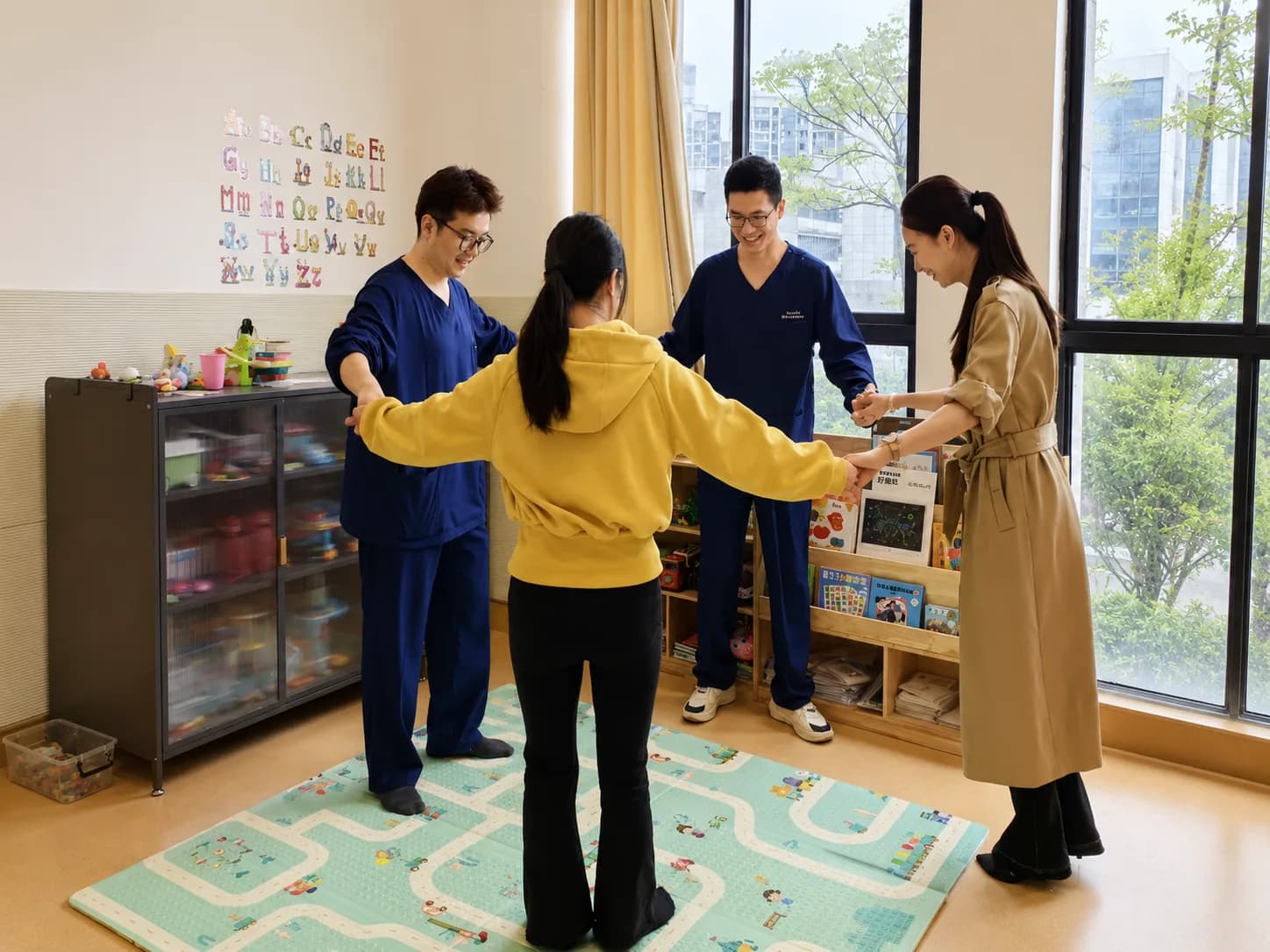
Super Skills is an internationally standardised social skills training system for children with autism. Based on real-life social scenarios and a scientific step-by-step approach, children learn the rules of communication, communication skills, and emotional regulation; confidence, cooperation, and the ability to integrate into a group are built. The principle of 'applied socialisation' — "learn it, apply it" — means that skills are immediately practised in situations close to life, rather than in artificially isolated training conditions.
At the Hanshi NeuroLife International Rehabilitation Center in Shangrao, Super Skills is the core of stage O (Open Social) of the GROW program (mental age 4 years 6 months – 6 years). At this stage, the child has already formed foundational learning skills and readiness for group work (stage R), and the focus shifts to the core issue of ASD — socialisation. The format combines group interaction with individual support: children train social scenarios in a group while the specialist accompanies each child personally. The method is combined with PCI, DIR/Floortime, and Theory of Mind (ToM) at advanced stages.
Advantages of the method as delivered at the centre: an international standard with a mature evidence base; applied skills usable in life; step-by-step growth from basics to complexity; realistic situational modelling; combination of group and individual format; family continuity — parents are easily coached and reinforce skills at home.
What matters for the parent
Super Skills is applied socialisation for life, not a theoretical 'etiquette course'. The goal is for the child to be able to act with confidence in real social situations: at kindergarten, at school, at home, in public places. Family continuity is one of the principles: parents are coached on specific techniques to support social practice in daily-living situations. This significantly enhances the outcome.
Initial assessment of social skills and readiness
Specialists assess the level of social skills, motivation to interact, and the capacity for independent group work (readiness for stage O). The starting level of the programme is selected.
Selection of an individualized programme via the step-by-step model
The programme is built in steps: from basic skills (greeting, turn-taking) to more complex ones (emotions, refusals, conflicts) and further to flexible social adaptation.
Regular sessions in a group format with individual support
Children train social scenarios in a peer group; the specialist accompanies each child personally. The principle — 'learn it, apply it' in realistic situations.
Family continuity and consolidation in everyday life
Parents are coached on specific techniques to support social practice in daily-living situations (kindergarten, public places, family). This significantly enhances the outcome.
Progress reassessment and transition to adaptation in the real environment
Regular reassessment of the skills mastered; combination with PCI (Parent–Child Interaction), DIR/Floortime, and Theory of Mind (ToM) at advanced stages; transition to stage W (school adaptation) and inclusion in the real environment.
Indications and contraindications
Indications
Contraindications
Who performs the procedure

What diagnoses it helps with Super Skills — Social Skills Training
Book a free consultation
Leave a short request — a coordinator will contact you within 5 minutes, answer your questions and suggest the first steps.