
Sensory Integration (SI)
Professional game-based training of sensory processing on specialised equipment — the foundation for the development of attention, emotion, speech, and social skills.
How the procedure works
Sensory Integration (SI) is the brain's ability to process and integrate signals from different sensory systems (visual, auditory, tactile, vestibular, proprioceptive) and produce an adaptive response. In children with sensory integration disorder this ability is impaired — hence sensory hyper- or hyposensitivity, poor coordination, attention deficit, and emotional instability. Sensory integration is one of the key focus areas of rehabilitation at the centre, because sensory processing is the foundation on which the development of attention, emotion, speech, cognition, and social skills is built. Without a stable sensory foundation, the rest of the work often 'stays in place'.
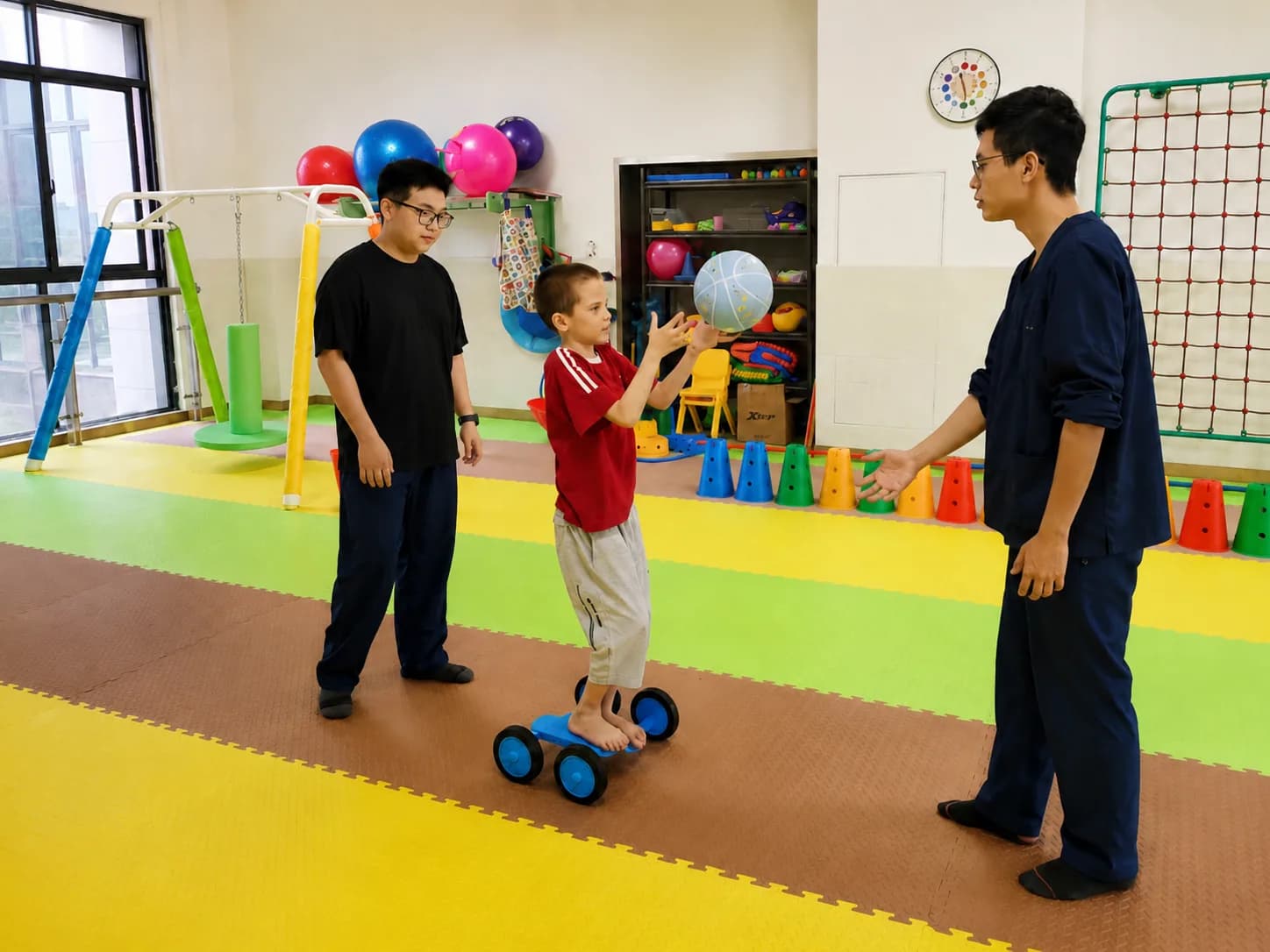
At the Hanshi NeuroLife International Rehabilitation Center in Shangrao, sensory integration is conducted on specialised equipment — swings, hammocks, tunnels, spinning discs, and balls. Each element gives the child a specific type of sensory input in a playful and safe form. The working principles: sensory input as the basis, integration in the brain as the goal; first emotional stabilisation, then development of abilities; strengthening body control → brain development. The method is combined with occupational therapy (OT), Orff music therapy, PT, ABA, and other directions of the programme. It suits a wide range of conditions: from ASD and sensory integration disorder to cerebral palsy, post-encephalopathy, and motor impairments.
Advantages of the method as delivered at the centre: professional assessment before sessions; playful format without resistance; individualized selection of exercises; simultaneous strengthening of the body and emotional stabilisation; safe specialised equipment; a system adapted for ASD.
What matters for the parent
Progress in sensory integration is usually visible within 4–8 weeks of regular work. Part of the exercises requires equipment and is conducted only at the centre, but parents are given specific home games. The yard is not a substitute for the course: what matters is not the sensory input itself, but its precise matching to the child's specific impairments and systematic, regular work.
Professional assessment of the sensory profile
Specialists assess sensitivity in each sensory system (tactile, vestibular, proprioceptive, auditory, visual), as well as coordination, attention, and emotional stability.
Selection of an individualized exercise programme
Specific exercises and equipment (swings, hammocks, tunnels, spinning discs, balls) are matched to the child — precisely dosed sensory input following the principle 'first emotional stabilisation, then development'.
Regular sessions on specialised equipment
Game-based sensory-integrative sessions in a safe setting. Children do not resist — the format is playful, the equipment is engaging. Each sensory input is monitored for the response.
Coaching parents on home sensory games
Part of the exercises requires equipment and is conducted only at the centre, but parents are given specific home games. Regular home practice reinforces the effect of the course.
Progress reassessment and integration with other methods
Regular reassessment of the sensory profile; combined with occupational therapy (OT), Orff music therapy, PT, and ABA. Sensory processing is the foundation on which the development of attention, speech, cognition, and social skills is built.
Explore the Room in 360°
Click and drag to look around the room
Indications and contraindications
Indications
Contraindications
Who performs the procedure






What diagnoses it helps with Sensory Integration (SI)
Book a free consultation
Leave a short request — a coordinator will contact you within 5 minutes, answer your questions and suggest the first steps.